Beanlings Booster: Hilfe
Lieber Schritt für Schritt mit Bildern? Hier ist der Guide.
Ein Beanlings-Spiel zum Sammeln: Booster öffnen, Karten aufdecken, den Binder füllen und mit Freunden tauschen. Auf den Karten sind gezeichnete Tiere, Beanlings und Wesen aus den Wildlands. Der Rahmen zeigt die Seltenheit: Holz, Moosholz, Silber, Platin, Messing, Gold, Ebenholz, roter Lack, Elfenbein.
Wie komme ich an Booster?
- Jeden Tag gibt es einen Gratis-Booster. Ein neuer Tag beginnt um 00:00 Uhr (deutsche Zeit). Verpasste Tage sammeln sich nicht an.
- Beim ersten Besuch mit Konto gibt es zusätzlich einen Willkommens-Booster.
- In Konterjagd verdienst du Booster: Platz 1 bis 3 deiner Wochen-Staffel und ein erreichtes Wochenziel bringen je einen Booster.
- Wer ein Set vollständig sammelt, bekommt 3 Booster.
- Newsletter: Meldest du dich in der App (Start oder „Info“) zum Beanlings-Newsletter an und bestätigst den Link in der Mail, bekommst du einmalig 2 Bonus-Booster (einmal je Konto und je E-Mail-Adresse). Warst du schon vorher dabei, holst du den Bonus mit dem Knopf „Bonus-Booster abholen“.
- Sonderverlosung: Mit bestätigtem Newsletter bist du jede Woche automatisch dabei. Montags werden 3 Gewinner gezogen; jeder bekommt einen Sonder-Booster mit mindestens einer epischen Karte. Du siehst den Gewinn beim nächsten Öffnen. Regeln: Teilnahmebedingungen. Abbestellen geht jederzeit (Link in jeder Mail oder unter „Info“), dann endet die Teilnahme.
Ohne Anmeldung kannst du einen Probe-Booster öffnen. Gespeichert wird erst mit deinem Beanlings-Konto (dasselbe Konto für alle Beanlings-Spiele).
Stufen und Chancen
Ein Booster hat 5 Karten. Jede Karte bekommt auf dem Server eine Stufe, unabhängig von den anderen. Jedes Motiv kann in jeder Stufe erscheinen. Ab Legendär ist jede Karte nummeriert, zum Beispiel #7 von 250. Ist die Auflage eines Motivs in einer Stufe vergeben, wird die Karte eine Stufe tiefer gezogen.
Zusätzlich kann jede Karte eine Variante haben: eine andere Farbe mit Glitzer, ein Sonderbild mit Szene oder einen Fehldruck. Die ersten 100 gezogenen Exemplare jedes Motivs tragen den Stempel Erstausgabe. Varianten lassen sich kombinieren.
Folien
Dazu kann eine Karte eine Folie haben, höchstens eine Folienart je Karte und mit allen Varianten kombinierbar: Reverse-Folie (alles außer dem Bild glänzt), Bildfolie (nur das Bild glänzt), Sternfolie (feine Sterne blitzen beim Kippen auf), Strukturfolie (eingeprägte Linien im Rahmen), Prismafolie (Regenbogen-Brechung über die ganze Karte) und Goldfolie (warmer Goldglanz, nur ab Episch). In der Großansicht folgt das Licht deinem Finger oder der Maus; am Handy tippst du auf „Folie bewegen“ und kippst es. Im Binder zeigt die Plakette ein Zeichen je Folienart, der Filter „Folie“ zeigt nur Folienkarten. Folie ist reiner Sammelwert: keine Spielwerte, nur ein kleiner Zuschlag bei den Sammelpunkten (je Motiv und Folienart einmal).

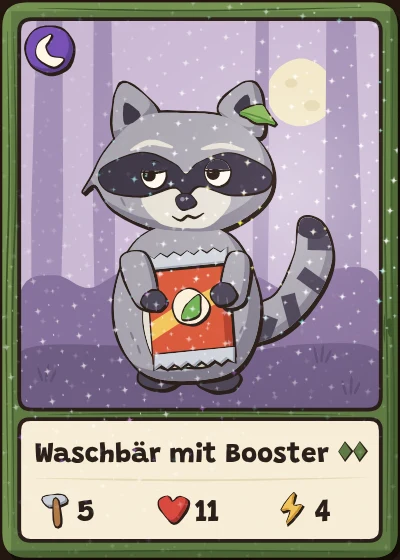
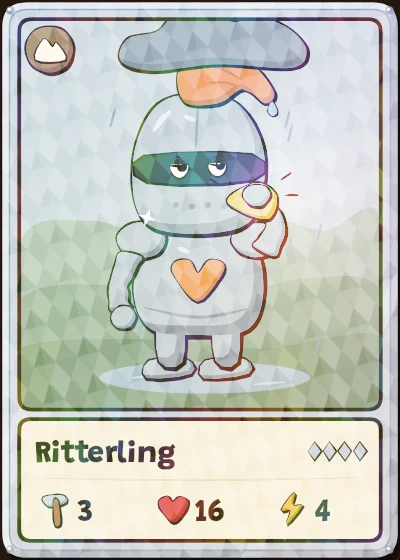
Jede Ziehung wird mit einer eigenen Saat auf dem Server protokolliert. Niemand, auch wir nicht, kann einzelne Karten gezielt vergeben.
Binder und Sets
Im Binder siehst du jedes Motiv eines Sets. Fehlende Motive erscheinen grau. Jede Karte trägt unten eine Plakette: das Kürzel ihrer Stufe (ab Legendär mit Nummer), „×2“ und mehr, wenn du sie öfter hast, und kleine Zeichen für Glanzform (G), Sonderbild (S), Fehldruck (F) und Erstausgabe (1), dazu ein Zeichen je Folienart. Oben zählt eine Übersicht deine Karten je Stufe; tippst du eine Stufe an (oder nutzt die Filterleiste), siehst du nur diese Stufe und grau, welche Motive dir dort noch fehlen. Ein Set ist vollständig, wenn du jedes Motiv in irgendeiner Stufe hast. Dafür gibt es 3 Booster, einen Set-Rahmen und ein Abzeichen. Karten in Glanzform liegen zusätzlich in einem eigenen Fach.
Funken und Werkstatt
Doppelte Karten ohne Nummer und ohne Variante werden beim Öffnen sofort zu Funken. Mit Funken stellst du in der Werkstatt gezielt fehlende Motive her, bis zur Stufe Episch. Hergestellte Karten haben keine Nummer und keine Variante. Legendär und höher lassen sich nie herstellen. Karten mit Nummer oder Variante kannst du von Hand zerlegen. Funken kann man nicht kaufen, nicht tauschen und nicht in Geld oder eine andere Währung umwandeln.
Ohne Geld ist ein Set in etwa 3 bis 5 Wochen vollständig.
Tauschen mit Freunden
Du tauschst nur mit deinen Freunden, immer eine Karte gegen eine Karte. Einer bietet an, der andere nimmt an. Bei Mythisch, Göttlich und Einzelstück gilt danach eine Wartezeit von 24 Stunden, dann bestätigen beide noch einmal. So passiert nichts aus Versehen. Getauscht wird nie gegen Geld, Tinte, Bohnen, Coins oder Funken.
Was bringen die Karten?
Auf jeder Karte steht, was sie freischaltet. Freischaltungen sind Kosmetik oder Sammelwert, nie ein Vorteil in einem anderen Spiel:
- Jede Karte kannst du als Profilbild nutzen.
- Einige Karten schalten in Konterjagd Ballspuren oder ein Trikot frei, zum Beispiel der Drache ab Selten die Spur „Glut“.
- Wesen aus den Wildlands bekommen später einen Lexikon-Eintrag in Wildlands.
- Ab Ultra Selten schalten viele Karten einen Binder-Rahmen frei.
Freigeschaltetes bleibt, auch wenn du die Karte später tauschst.
Karten groß ansehen
Tippe eine Karte an, egal ob gerade gezogen oder im Binder: Sie erscheint bildschirmfüllend und gestochen scharf. Wo du Karten auswählst (Duell, Deck, Tausch), wählt Tippen aus; groß wird sie dort über die Lupe oder langes Drücken. Wische zur Seite, um sie umzudrehen. Auf der Rückseite stehen Werte, Element, Stärken und Schwächen, Fähigkeit, Herkunft, Nummer, Varianten, Folie und Erstausgabe. Bei Folienkarten folgt das Licht deinem Finger, ein schneller Wisch dreht um. Nach unten wischen oder das X schließt sie. Mit „Als Bild teilen“ bekommst du die Karte als Bild, deinen Namen nur, wenn du das Häkchen setzt.
Pfadduell
Im Pfadduell spielst du mit einem Deck aus 8 Karten auf drei Pfaden. Die Elemente sind dieselben wie in den Wildlands: Feuer schlägt Pflanze und Eis, Wasser schlägt Feuer und Erde, Pflanze schlägt Wasser, Eis schlägt Pflanze und Luft, Erde schlägt Feuer, Luft schlägt Pflanze, Licht und Schatten schlagen sich gegenseitig.
- Deck: 8 verschiedene Karten aus deiner Sammlung. Du kannst mehrere Decks speichern, einen Vorschlag gibt es automatisch. Du startest mit 4 Karten auf der Hand und ziehst jede Runde 1 nach.
- Ablauf: 4 Runden. Ihr legt gleichzeitig und verdeckt, höchstens 1 Karte je Pfad und Runde, höchstens 2 Karten je Pfad und Seite. Dann wird aufgedeckt. Legen: Karte in der Hand antippen, dann deinen Platz auf einem Pfad. Nochmal antippen nimmt sie zurück.
- Glut: Runde 1 hast du 2 Glut, danach jede Runde 1 mehr. Was übrig bleibt, verfällt. Jede Karte kostet 1 bis 4 Glut, je nach Werten und Fähigkeit, nie nach der Seltenheit.
- Werte auf dem Pfad: Macht (aus Kraft und Tempo) ist die Stärke einer Karte. Das Gelände über dem Pfad gibt dem passenden Element +2, einem vom Gelände geschlagenen Element -1. Element-Vorteil gegen eine gegnerische Karte auf demselben Pfad: +1. Passende Elemente auf Nachbarpfaden (Feuer und Luft, Wasser und Pflanze, Erde und Eis, Licht und Schatten) und Karten derselben Familie nebeneinander: je +1.
- Verdrängen: Bist du auf einem Pfad um mindestens den Halt der schwächsten gegnerischen Karte vorn, muss sie den Pfad verlassen. Der Halt kommt aus dem Leben. Nur hier zählt die Seltenheit: seltene Karten haben bis zu 3 Leben mehr.
- Fähigkeiten: Vorsprung (die stärkste gegnerische Karte auf dem Pfad -2), Schutzkreis (jeder eigene Nachbarpfad +2), Wucht (gewinnt ihr Pfad, springt der Überschuss bis 3 auf den Pfad rechts daneben), Zähigkeit (übersteht einmal das Verdrängen), Wildheit (+3, solange du nach Pfaden hinten liegst), Heimvorteil (doppelter Gelände-Bonus).
- Sieg: Nach Runde 4 gewinnt, wer 2 von 3 Pfaden mit der höheren Summe hält. Gleichstand auf einem Pfad: mehr Tempo, dann das Los.
- Gegner: die KI in drei Stärken, „Gegner suchen“ (ein Mensch mit ähnlicher Wertung, live mit 30 Sekunden je Runde) oder ein Freund. Ist niemand live da, kannst du zeitversetzt gegen einen echten Menschen spielen: Jeder legt, wann er Zeit hat, 24 Stunden je Runde. Läuft die Zeit ab, legt die KI für dich, und die Partie wird gekennzeichnet. Wer oft abbricht, verliert Wertung.
- Wertung: Start bei 1000, Stufen von Lichtung bis Gipfel. Nur Partien aus der Spielsuche zählen.
- Fair: Kein Chat, nur feste Kurzreaktionen. Melden und Blockieren geht im Menü der Partie. Für Siege gibt es ein paar Funken (höchstens 20 am Tag) und bei 5 Siegen in einer Woche einen Booster. Es gibt keinen Einsatz: Deine Karten gehen nie verloren.
Beim ersten Mal zeigt dir eine Übungspartie in drei geführten Runden, worauf es ankommt.
Community und Ranglisten
Unten im Bereich „Community“ findest du die Ranglisten. Pfadduell „Diese Woche“ zählt deinen Wertungsgewinn aus Duellen gegen Menschen seit Montag 00:00; „Gesamt“ zeigt deine Wertung und Stufe. In beiden Listen stehst du ab 3 gewerteten Duellen gegen Menschen, KI-Partien zählen nicht. Die Sammler-Rangliste zählt Sammelpunkte: jedes Motiv je Seltenheit einmal (Gewöhnlich 1 bis Einzelstück 2000), dazu Binder-Fortschritt und verschiedene Karten.
Platz 1 bis 3 der Wochen-Rangliste bekommen am Montag je 1 Gratis-Booster (zusätzlich, zählt nicht gegen die Tagesgrenze) und eine Woche lang ein Ehrenabzeichen am Namen. Unter „Neues“ stehen seltene Funde ab Episch, Rangaufstiege und Wochensieger, dazu die Fundwand. Möchtest du nicht mit Namen erscheinen, schalte „In Ranglisten anonym erscheinen“ ein; dann steht dort „Ein Sammler #“ mit vier Zeichen. Es gibt keinen Chat in der App; zum Austausch geht es von dort in den eigenen Booster-Bereich im Beanlings-Discord (Chat, Duelle verabreden, Top-Pulls ab Mythisch, Turnier-News). Mit „Mit Discord verbinden“ bekommst du dort die Rolle Booster, nach Turnier-Platz 1 bis 3 oder einem Fund ab Mythisch weitere Rollen. Dein Name erscheint bei Top-Pulls nur mit Fundwand-Freigabe.
Liga
Die Liga läuft jede Woche von Montag 00:00 bis Sonntag 23:59. Es gibt fünf Ligen: Lichtung, Hain, Grat, Kamm und Gipfel; alle beginnen in der Lichtung. Du findest sie unter „Community“, „Pfadduell“, „Liga“ (oder im Bereich „Spielen“). Mit „Liga beitreten“ oder deinem ersten Liga-Duell der Woche kommst du in eine Gruppe mit 8 Plätzen. Plätze ohne Menschen füllt die Pfadduell-KI; sie sind immer mit „KI“ gekennzeichnet, nie als Mensch getarnt. Kommt ein weiterer Mensch deiner Liga dazu, übernimmt er einen KI-Platz.
Jeder spielt jeden in der Gruppe einmal: gegen Menschen zeitversetzt (24 Stunden je Runde) oder live nach einer Anfrage (30 Sekunden je Runde), gegen KI-Plätze sofort. Die KI-Plätze spielen untereinander nach Spielplan, ein Spieltag je Wochentag. Sieg 3, Unentschieden 1, Niederlage 0. Was am Sonntag noch offen ist, legt die KI gekennzeichnet zu Ende; eine Partie, in der du keinen eigenen Zug gemacht hast, zählt als verloren.
Beim ersten Aufruf ab Montag wird ausgewertet: Platz 1 und 2 steigen auf (aus dem Gipfel geht es nicht höher), ab dem Grat steigen die letzten 2 ab; aus Lichtung und Hain steigt niemand ab. Wer in der Woche keine Partie beendet hat, bleibt in seiner Liga. Lohn sind nur Booster: Platz 1 bis 3 bekommen je nach Liga 1 bis 4 Booster (höhere Ligen mehr), zusätzlich und ohne Tagesgrenze. Liga-Partien ändern deine Elo-Wertung nicht.
Turniere
Feierabend-Turnier: jeden Mittwoch 19:00 bis 22:00 live, 3 Runden (19:00, 20:00, 21:00). Tritt bis 10 Minuten nach Rundenbeginn an, danach gelten 30 Sekunden je Zug. Klassen: Einsteiger (Lichtung, Hain) und Fortgeschrittene (ab Grat).
Wochenend-Turnier: Samstag 10:00 bis Sonntag 22:00 zeitversetzt, 5 Runden (Sa 10:00, Sa 17:00, So 00:00, So 07:00, So 14:00), höchstens 12 Stunden je Zug und nie über das Rundenende hinaus. Klassen: Einsteiger (Lichtung, Hain), Fortgeschrittene (Grat, Kamm), Meister (Gipfel).
Anmelden geht mit einem Tipp bis zum Start. Gespielt wird im Schweizer System: Jede Runde triffst du jemanden mit ähnlich vielen Punkten, nie zweimal denselben. Sind in einer Klasse weniger als 4 Menschen, füllt die KI auf (gekennzeichnet); ohne Anmeldung fällt das Turnier mit Hinweis aus. Preise: Booster für Platz 1 bis 3, eine Woche lang ein Turnier-Abzeichen am Namen und ein Eintrag unter „Neues“. Plätze der KI bekommen nichts. Seltenheit bringt in Liga und Turnieren keinen Vorteil. Admin-Konten mit Test-Boostern spielen nicht mit.
Promo-Karten: Jedes Turnier hat eine eigene Promo-Karte (je nach Turnier und Woche des Monats, ab dem 29. wieder Woche 1), nie im Booster. Wer mindestens 2 Runden selbst spielt, bekommt sie; Platz 1 bis 3 bekommen die Gold-Fassung. Nicht zerlegbar, nicht herstellbar, tauschbar mit Freunden, im Pfadduell gleich stark wie jede andere Karte. Im Binder stehen sie im Abschnitt „Promo“.
Kaufen, Chancen, Schutz
Booster lassen sich auch mit Tinte kaufen, sobald der Kauf freigeschaltet ist. Dafür gelten feste Regeln:
- Gleiche Chancen wie bei Gratis-Boostern. Seltene Stufen werden gegen Geld nicht wahrscheinlicher.
- Garantie: Jeder gekaufte Booster enthält mindestens eine Karte Selten oder besser. Spätestens der 10. gekaufte Booster ohne Episch oder besser enthält ein Episch. Den Zähler siehst du vor jedem Kauf.
- Preise: 1 Booster 99 Tinte (0,99 €), 5 Booster 449 Tinte (4,49 €), 10 Booster 849 Tinte (8,49 €).
- Gekaufte Karten sind an dein Konto gebunden und nicht tauschbar. Das gilt auch für Karten, die du mit Funken aus gekauften Karten herstellst.
- Bezahlt wird nur mit Tinte, nur im Browser, nie in den Apps. Es gibt keinen Rücktausch und keine Auszahlung.
- Beanlings Booster ist ab 18 Jahren, also auch der Kauf.
- Grenzen: höchstens 1000 Tinte und 10 Booster am Tag, höchstens 2000 Tinte im Monat.
- Mit der Kaufsperre sperrst du Käufe für dich selbst. Sie wirkt sofort. Aufheben wirkt erst nach 24 Stunden.
Alles, was du zum Sammeln brauchst, bekommst du auch ohne Geld.
Ab 18
Beanlings Booster ist ab 18 Jahren. Vor dem ersten Booster bestätigst du einmal, dass du mindestens 18 bist; bei einem neuen Konto geschieht das bei der Registrierung. Gäste können ohne Konto einen Probe-Booster öffnen, dabei wird nichts gespeichert.
Einstellungen und Daten
Du meldest dich mit deinem Beanlings-Konto an. In den Einstellungen (Zahnrad oben, auch im Bereich Info) findest du: Konto und Abmelden, Sprache, Privatsphäre (Name auf der Fundwand, anonym in Ranglisten), Newsletter, Discord, Effekte (Bewegung reduzieren, Folie folgt dem Neigen) und deine Daten. Mit „Meine Booster-Daten herunterladen“ bekommst du sofort eine Datei mit allem, was Beanlings Booster zu dir speichert. Mit „Booster-Daten löschen“ löschst du nach doppelter Bestätigung alle deine Booster-Daten; dein Beanlings-Konto bleibt. Wird dein ganzes Konto gelöscht, verschwinden auch deine Karten und Funken. Vergebene Nummern bleiben vergeben.
Beanlings Booster: Help
Prefer step by step with pictures? Here is the guide.
A Beanlings game for collectors: open boosters, reveal cards, fill your binder and trade with friends. The cards show hand-drawn animals, Beanlings and creatures from the Wildlands. The frame shows the rarity: wood, moss wood, silver, platinum, brass, gold, ebony, red lacquer, ivory.
How do I get boosters?
- Every day there is one free booster. A new day starts at midnight (German time). Missed days do not pile up.
- On your first visit with an account you also get a welcome booster.
- In Konterjagd you earn boosters: places 1 to 3 of your weekly group and a reached weekly goal give one booster each.
- Completing a set gives you 3 boosters.
- Newsletter: If you sign up for the Beanlings newsletter in the app (start screen or “Info”) and confirm the link in the e-mail, you get 2 bonus boosters once (once per account and per e-mail address). Already subscribed? Collect the bonus with the button “Collect bonus boosters”.
- Special draw: With a confirmed newsletter you take part automatically every week. Every Monday 3 winners are drawn; each gets a special booster with at least one epic card. You see the win the next time you open the app. Rules: terms. You can unsubscribe at any time (link in every e-mail or under “Info”); your participation then ends.
Without signing in you can open one trial booster. Progress is saved with your Beanlings account (the same account for all Beanlings games).
Tiers and odds
A booster has 5 cards. Each card gets its tier on the server, independently of the others. Every motif can appear in every tier. From Legendary upwards each card is numbered, for example #7 of 250. If a motif's print run in a tier is used up, the card is drawn one tier lower.
Each card can also have a variant: a different colour with glitter, a special art with a scene, or a misprint. The first 100 copies pulled of each motif carry the Erstausgabe stamp. Variants can combine.
Foils
A card can also carry a foil, at most one kind per card and combinable with every variant: Reverse Foil (everything but the artwork shines), Art Foil (only the artwork shines), Star Foil (fine stars flash when you tilt it), Textured Foil (embossed lines in the frame), Prism Foil (rainbow refraction across the whole card) and Gold Foil (warm golden sheen, Epic and above only). In the large view the light follows your finger or mouse; on a phone tap “Move the foil” and tilt it. In the binder the badge shows a mark for each kind of foil, and the “Foil” filter shows only foil cards. Foil is purely for collecting: no game stats, just a small bonus to your collector points (once per motif and kind of foil).

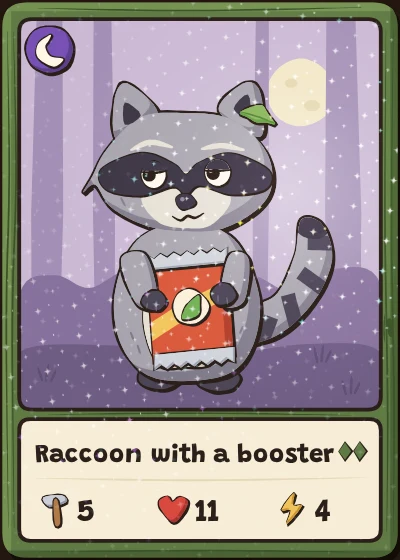
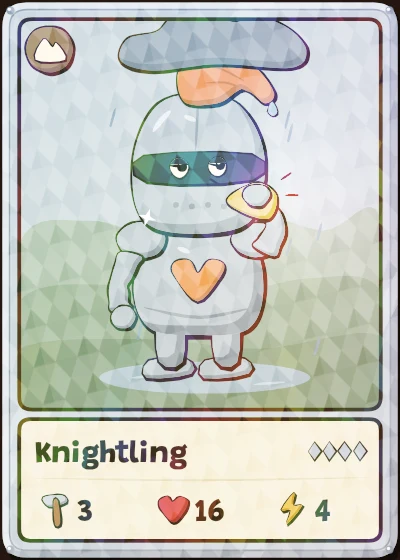
Every draw is logged on the server with its own seed. Nobody, not even us, can hand out specific cards.
Binder and sets
Your binder shows every motif of a set. Missing motifs appear grey. Every card has a badge at the bottom: its rarity code (from Legendary with its number), “×2” and up if you own it more often, and small marks for Glowform (G), Special Art (S), misprint (F) and first edition (1), plus a mark for each kind of foil. At the top an overview counts your cards per rarity; tap a rarity (or use the filter bar) to see only that rarity and, in grey, which motifs you are still missing there. A set is complete when you own every motif in any tier. That gives you 3 boosters, a set frame and a badge. Glowform cards also go into their own shelf.
Sparks and workshop
Duplicate cards without a number and without a variant turn into sparks right away. In the workshop you craft missing motifs with sparks, up to the Epic tier. Crafted cards have no number and no variant. Legendary and above can never be crafted. Cards with a number or variant can be broken down by hand. Sparks cannot be bought, traded or turned into money or any other currency.
Without spending money a set is complete in about 3 to 5 weeks.
Trading with friends
You only trade with your friends, always one card for one card. One offers, the other accepts. For Mythic, Divine and One of a kind there is a 24 hour waiting time, then both confirm again. That way nothing happens by accident. Trades never involve money, Ink, beans, coins or sparks.
What do cards unlock?
Every card says what it unlocks. Unlocks are cosmetic or collector value, never an advantage in another game:
- Every card can be your profile picture.
- Some cards unlock ball trails or a kit in Konterjagd, for example the Dragon from Rare unlocks the trail “Ember”.
- Creatures from the Wildlands will later get a lexicon entry in Wildlands.
- From Ultra Rare many cards unlock a binder frame.
Unlocks stay, even if you trade the card later.
View cards large
Tap any card, freshly pulled or in the binder: it fills the screen, pixel sharp. Where you pick cards (duel, deck, trade), tapping selects; there you view it large with the magnifier or a long press. Swipe sideways to flip it. The back shows stats, element, strengths and weaknesses, ability, origin, number, variants, foil and Erstausgabe. On foil cards the light follows your finger, a quick swipe flips. Swipe down or tap X to close. “Share as image” gives you the card as a picture, with your name only if you tick the box.
Path duel
In the path duel you play with a deck of 8 cards on three paths. The elements are the same as in the Wildlands: fire beats plant and ice, water beats fire and earth, plant beats water, ice beats plant and air, earth beats fire, air beats plant, light and shadow beat each other.
- Deck: 8 different cards from your collection. You can save several decks, a suggestion is made automatically. You start with 4 cards in hand and draw 1 each round.
- Flow: 4 rounds. You play at the same time and face down, at most 1 card per path and round, at most 2 cards per path and side. Then everything is revealed. To play: tap a card in your hand, then your spot on a path. Tap it again to take it back.
- Embers: 2 embers in round 1, then 1 more each round. Whatever is left expires. Each card costs 1 to 4 embers depending on its stats and ability, never on its rarity.
- Values on the path: Might (from power and speed) is a card’s strength. The terrain above the path gives the matching element +2 and an element beaten by the terrain -1. Element edge against an opposing card on the same path: +1. Matching elements on neighbouring paths (fire and air, water and plant, earth and ice, light and shadow) and cards of the same family side by side: +1 each.
- Pushing off: If you lead a path by at least the hold of the opponent’s weakest card there, it has to leave the path. Hold comes from life. Only here rarity counts: rare cards have up to 3 more life.
- Abilities: Head start (the strongest opposing card on the path -2), Guard circle (each of your neighbouring paths +2), Impact (if her path wins, the surplus up to 3 jumps to the path on the right), Toughness (survives being pushed off once), Wildness (+3 while you are behind on paths), Home advantage (double terrain bonus).
- Winning: After round 4, whoever holds 2 of 3 paths with the higher total wins. Tie on a path: more speed, then the draw.
- Opponents: the AI in three levels, “Find opponent” (a human with a similar rating, live with 30 seconds per round) or a friend. If nobody is live, you can play turn-based against a real human: everyone plays when they have time, 24 hours per round. If your time runs out, the AI plays for you and the game is marked. Abandoning often costs rating.
- Rating: starts at 1000, tiers from Clearing to Summit. Only matchmaking games count.
- Fair: No chat, only fixed quick reactions. Report and block in the game menu. Wins earn a few sparks (at most 20 per day) and 5 wins in a week earn a booster. There is no stake: your cards are never lost.
The first time, a practice game with three guided rounds shows you what matters.
Community and leaderboards
The “Community” area at the bottom holds the leaderboards. Path duel “This week” counts the rating you gained in duels against people since Monday 00:00; “All time” shows your rating and tier. You appear in both lists after 3 rated duels against people; AI games do not count. The collector leaderboard counts collection points: each motif once per rarity (Common 1 up to One of a kind 2000), plus binder progress and different cards.
Places 1 to 3 of the weekly leaderboard each get 1 free booster on Monday (extra, not counted against the daily limit) and an honour badge next to their name for one week. “Latest” shows rare finds from Epic upwards, rank-ups and weekly winners, plus the find wall. If you do not want to appear with your name, switch on “Appear anonymously in leaderboards”; it then shows “A collector #” with four characters. There is no chat in the app; for a chat, head from there to the Booster area of the Beanlings Discord (chat, arrange duels, top pulls from Mythic, tournament news). “Connect with Discord” gives you the Booster role there, plus more roles for places 1 to 3 in tournaments or a find from Mythic. Your name only shows with top pulls if you allow it on the find wall.
League
The league runs every week from Monday 00:00 to Sunday 23:59. There are five leagues: Clearing, Grove, Ridge, Crest and Summit; everyone starts in Clearing. You find it under “Community”, “Path duel”, “League” (or in the “Play” area). With “Join the league” or your first league duel of the week you are placed in a group of 8. Places without people are filled by the path duel AI; they are always marked “AI”, never disguised as a person. When another person of your league joins, they take over an AI place.
Everyone plays everyone in the group once: against people turn-based (24 hours per round) or live after a request (30 seconds per round), against AI places right away. AI places play each other according to a schedule, one matchday per weekday. Win 3, draw 1, loss 0. Whatever is still open on Sunday is finished by the AI and marked; a game in which you made no move of your own counts as lost.
On the first visit from Monday the week is scored: places 1 and 2 are promoted (there is nothing above Summit), from Ridge upwards the last 2 are relegated; nobody is relegated from Clearing or Grove. If you finished no game that week, you stay in your league. Rewards are boosters only: places 1 to 3 get 1 to 4 boosters depending on the league (higher leagues more), extra and without a daily limit. League games do not change your Elo rating.
Tournaments
After-work tournament: every Wednesday 19:00 to 22:00 live, 3 rounds (19:00, 20:00, 21:00). Show up within 10 minutes of the round start, after that 30 seconds per move apply. Classes: Beginners (Clearing, Grove) and Advanced (from Ridge).
Weekend tournament: Saturday 10:00 to Sunday 22:00 turn-based, 5 rounds (Sat 10:00, Sat 17:00, Sun 00:00, Sun 07:00, Sun 14:00), at most 12 hours per move and never beyond the end of the round. Classes: Beginners (Clearing, Grove), Advanced (Ridge, Crest), Masters (Summit).
Sign up with one tap until the start. Pairings use the Swiss system: each round you meet someone with a similar score, never the same opponent twice. With fewer than 4 people in a class the AI fills up (marked); without sign-ups the tournament is cancelled with a notice. Prizes: boosters for places 1 to 3, a tournament badge next to your name for one week and an entry under “Latest”. AI places get nothing. Rarity gives no advantage in leagues and tournaments. Admin accounts with test boosters do not take part.
Promo cards: every tournament has its own promo card (depending on the tournament and the week of the month, from the 29th week 1 again), never in boosters. Play at least 2 rounds yourself to get it; places 1 to 3 get the gold version. Cannot be broken down or crafted, tradable with friends, as strong as any other card in the path duel. In the binder they have their own “Promo” section.
Buying, odds, protection
Once buying is switched on, boosters can also be bought with Ink. Fixed rules apply:
- Same odds as free boosters. Rare tiers do not get more likely for money.
- Guarantee: every bought booster contains at least one Rare or better. At the latest the 10th bought booster without Epic or better contains an Epic. You see the counter before every purchase.
- Prices: 1 booster 99 Ink (0.99 €), 5 boosters 449 Ink (4.49 €), 10 boosters 849 Ink (8.49 €).
- Bought cards are bound to your account and cannot be traded. This also applies to cards crafted with sparks from bought cards.
- Payment only with Ink, only in the browser, never in the apps. No refund into other currencies, no payout.
- Beanlings Booster is 18+, and so is buying.
- Limits: at most 1000 Ink and 10 boosters per day, at most 2000 Ink per month.
- With the purchase lock you block purchases for yourself. It works at once. Lifting it takes effect after 24 hours.
Everything you need for collecting is available without money too.
18+
Beanlings Booster is for ages 18 and up. Before your first booster you confirm once that you are 18 or older; for a new account this happens when you sign up. Guests can open a trial booster without an account, nothing is saved.
Settings and data
You sign in with your Beanlings account. In the settings (gear at the top, also in the Info area) you find: account and sign out, language, privacy (name on the find wall, anonymous in leaderboards), newsletter, Discord, effects (reduce motion, foil follows when you tilt) and your data. “Download my Booster data” gives you a file with everything Beanlings Booster stores about you right away. “Delete Booster data” deletes all your Booster data after a double confirmation; your Beanlings account stays. If your whole account is deleted, your cards and sparks are deleted too. Numbers already given out stay given out.